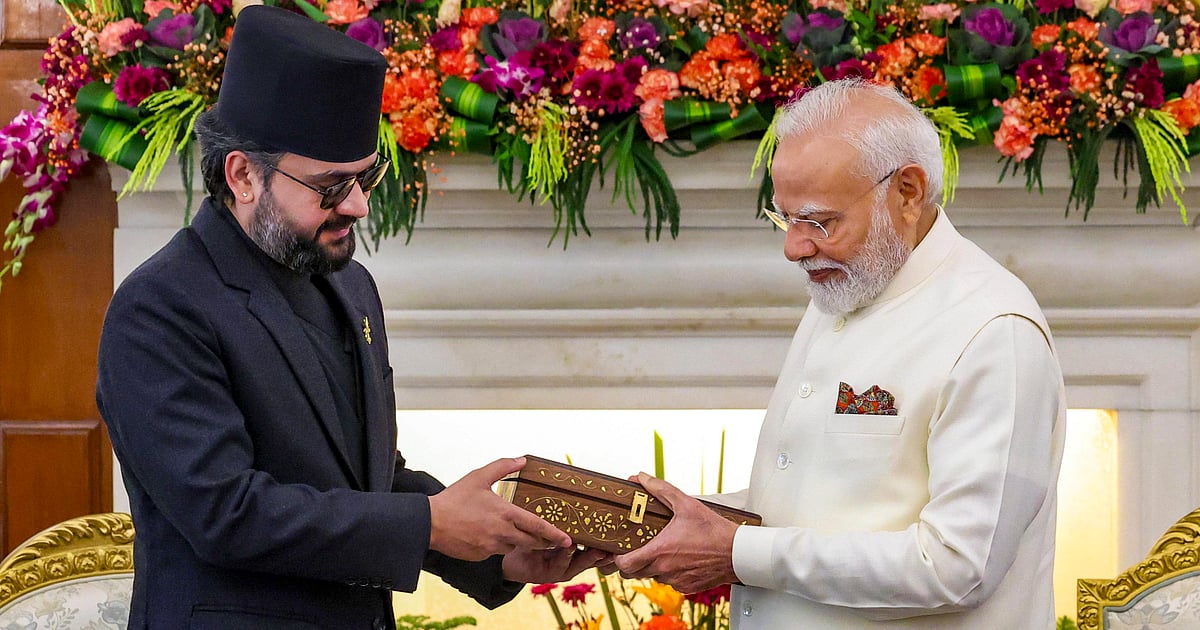
India on Monday announced a development assistance package of about ₹15,000 crore for Nepal and signed eight agreements with Kathmandu, in the most wide-ranging reset of the bilateral relationship in years, following talks between Prime Minister Narendra Modi and his Nepalese counterpart Balendra Shah in New Delhi.
The package, worth 24,000 crore Nepalese rupees, is aimed at Nepal's reconstruction after the devastating floods that struck the country in August, and at its longer-term development. It comprises NPR 5,600 million — roughly ₹3,500 crore — in grants for post-disaster reconstruction and infrastructure, and NPR 18,400 million, about ₹11,500 crore, extended as a line of credit for power-sector projects.
Eight pacts, from space to policing
The two countries signed eight memorandums of understanding covering forensic science, police training, civil-service capacity building, health and medicine, Ayurveda and traditional systems of medicine, sustainable urban development, satellite communication and agriculture. Among them are tie-ups between India's National Forensic Sciences University and Nepal Police, between Rashtriya Raksha University and Nepal's National Police Academy, and between the Indian Space Research Organisation and Nepal's Ministry of Information and Communication on a satellite communication network using the South Asia Satellite.
The leaders also adopted a joint vision document, titled "Viksit Bharat and Samunnat Nepal: Re-imagining the Partnership", setting out a ten-pillar framework for cooperation across trade, infrastructure, energy, water resources, connectivity, climate resilience, disaster management, sport, start-ups, digital services, space and innovation.
Trains, ports and power
Connectivity was the centrepiece of the visit. Mr. Modi and Mr. Shah virtually flagged off the Sarayu-Kamala Express, a new weekly train linking Ayodhya in Uttar Pradesh with Janakpur Dham in Nepal, passing through Gorakhpur, Raxaul, Sitamarhi and Jaynagar. India also agreed to give Nepal access to the Deendayal port at Kandla in Gujarat for its third-country transit trade, and the two sides laid the foundation stone for a 669 MW hydroelectric project and for the second phase of the Motihari–Amlekhgunj fuel pipeline.
India will additionally set up an offshore campus of an Indian Institute of Technology in Nepal, along with a start-up incubator and innovation centre, and offer more scholarships to Nepali students in law and technology.
A relationship under review
The two sides agreed to review the 1950 Treaty of Peace and Friendship and other existing agreements on the basis of mutual consent, and to resolve outstanding boundary, water, energy and trade issues through dialogue. Mr. Modi praised the 35-year-old Mr. Shah's vision for Nepal's development, saying the mandate given to him this year reflected the aspirations of the country's new generation. Mr. Shah thanked India for its reliable supply of petroleum products and other essential goods.
The visit was Mr. Shah's first bilateral trip abroad since taking office in March. For New Delhi, the scale of the package and the breadth of the agreements signal an effort to anchor the relationship with its Himalayan neighbour at a moment of political transition in Kathmandu — and to keep it firmly within India's orbit.

Comments (0)
No comments yet — be the first to share your view.