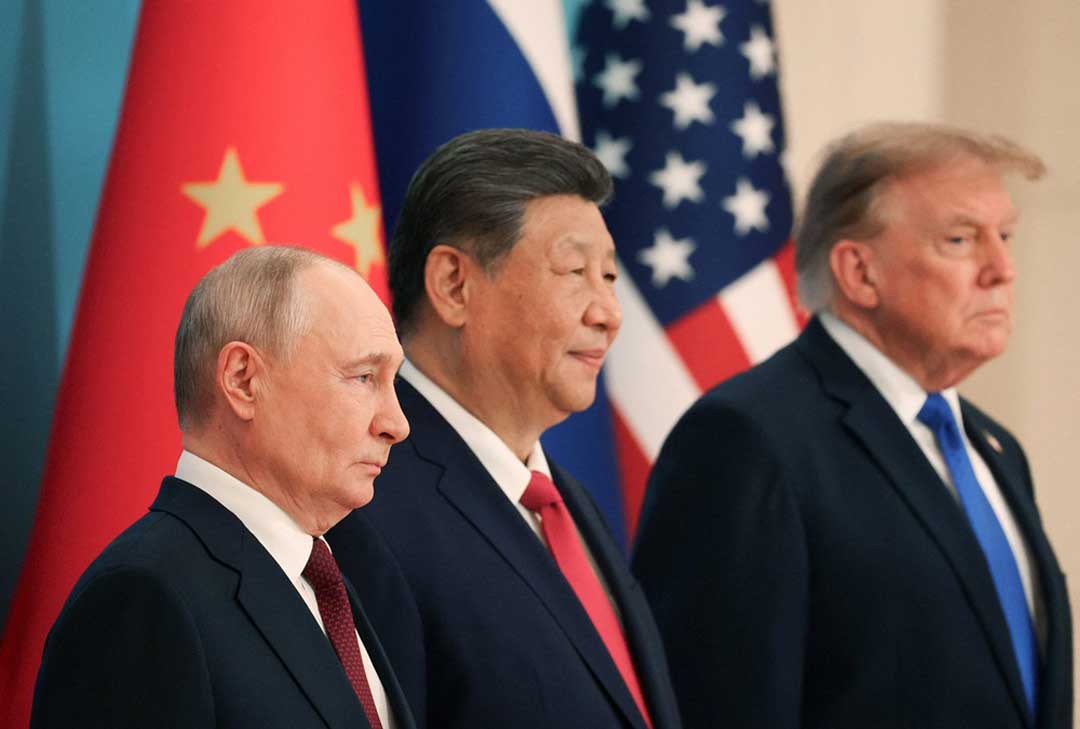
The leaders of the United States, China and Russia ended an unprecedented three-way summit in Shenzhen on Thursday with a symbolic "peace declaration" reaffirming that a nuclear war "cannot be won and must never be fought" — but announced no plans for arms-control talks and no progress on the wars in Ukraine or the Middle East.
The 90-minute meeting at Kylin Villa, a government guesthouse in Shenzhen, brought President Donald Trump together with Chinese President Xi Jinping and Russian President Vladimir Putin for the first-ever gathering of the leaders of the world's three largest nuclear powers. "We are really making history," Mr. Trump said as the three men opened the talks, seated around a large round wooden table beneath a towering Chinese landscape painting.
What the declaration says
The joint declaration, released by all three governments, contained four broad commitments: the countries would conduct a dialogue on reducing nuclear risks and preventing the proliferation of nuclear weapons; support reforms of the United Nations; increase the supply of refined petroleum products; and uphold the immunity of state officials in international courts. It gave no details of further meetings or how the commitments would be turned into concrete action.
Crucially, the declaration did not mention Russia's war in Ukraine or the United States' conflict with Iran. Mr. Putin acknowledged afterwards that it "did not set ambitious goals" and added that nobody would be forced to comply with its decisions. There was also no mention of negotiations on a trilateral nuclear arms reduction treaty — something Mr. Trump has pushed for since his first term and which China has consistently rejected, arguing that its arsenal is much smaller than those of the other two powers.
A spectacle with limited substance
Mr. Trump rated the meeting highly, telling NBC afterwards that it "went great" and, "on a scale of zero to 10, I think it was a 12. Fantastic relationships built." He told Reuters the summit was "bigger than Yalta," referring to the 1945 conference between the US, Britain and the Soviet Union.
Senate Democratic leader Chuck Schumer called the summit "a historic embarrassment," while German Chancellor Friedrich Merz dismissed it as "a photo opportunity" and warned against dividing Europe. Analysts said Mr. Putin was the clearest winner — gaining credibility and an escape from pariah status — while Mr. Xi burnished his credentials as the host who convened the world's great powers on Chinese soil. Mr. Xi said: "History tells us that when major powers live in harmony, the world is at peace. When major powers clash, the world falls into turmoil."
Mr. Trump came to the summit seeking to reassert himself internationally after his Republican Party lost control of Congress in the midterm elections this month. He is due to host the Group of 20 summit at his Florida golf resort in a few weeks, where he expects to meet Mr. Xi again — and possibly Mr. Putin, who said he would consider attending.

Comments (0)
No comments yet — be the first to share your view.