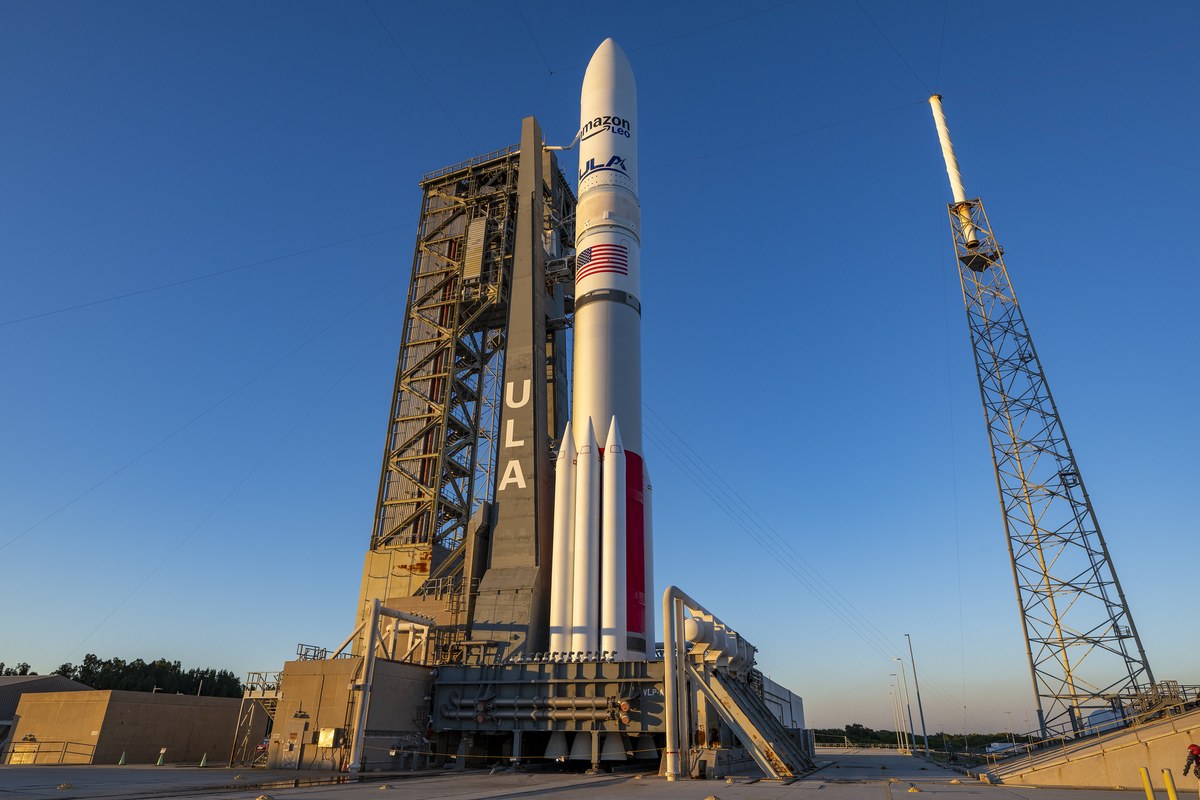
A United Launch Alliance (ULA) Vulcan rocket carrying 40 Amazon Leo internet satellites failed about 10 minutes after liftoff from Cape Canaveral on Sunday, destroying the payload in the launch company's first outright mission failure since it was formed in 2006.
The rocket lifted off from Space Launch Complex 41 at 12:40 pm ET on Sunday after two days of delays and a countdown hold with 20 seconds left to resolve a technical issue. About 50 minutes later, ULA confirmed the Vulcan vehicle had suffered an anomaly 10 minutes into the flight and failed to deliver the Amazon mission to orbit. The cause is not yet known.
The anomaly came during the burn of the Centaur upper stage, which carries the payload the rest of the way to orbit. Spaceflight Now reported the first stage, powered by two methane-burning BE-4 engines built by Blue Origin, appeared to burn longer than planned, and telemetry showed the Centaur making unusual orientation adjustments early in its burn. The rocket's six solid rocket boosters, made by Northrop Grumman, performed normally and burned out less than two minutes after liftoff. ULA said it would work with Amazon and other organisations to find the cause and return to flight as quickly as possible, but reports suggest a lengthy investigation could keep the rocket grounded for months.
A setback for Amazon's Starlink rival
The mission, designated Vulcan Leo 1, was the first of 38 Vulcan launches Amazon has purchased to build its Leo broadband constellation, designed to compete with SpaceX's Starlink. It was also the heaviest payload ULA has ever flown - the 40 satellites weighed more than 50,000 lb. Before Sunday, Amazon had 396 Leo satellites in orbit after 14 missions since April 2025, and plans to have all 3,232 first-generation satellites in service by July 2029, with initial commercial service due to begin this year. Amazon said there was risk with any launch, especially for inaugural missions like LV-01, and that it believed ULA would learn from this mission and deliver on its long-term plans.
Sunday's flight was only the fifth for Vulcan, which debuted in January 2024, and its first in nine months. The rocket had been grounded while ULA and Northrop Grumman investigated nozzle failures on solid rocket boosters that marred two earlier flights, in October 2024 and February 2025. Both flights still reached orbit, but the Space Force paused Vulcan national security launches after February, pending the outcome of Sunday's flight. ULA flew with an improved nozzle design, and its BE-4 engines had been retrofitted to fix the oxygen valve problem behind a Blue Origin New Glenn ground-test explosion in May.
ULA's failure ends a perfect record stretching back to the company's formation as a Boeing-Lockheed Martin joint venture in 2006 - some 170 missions without an outright loss. NASA Administrator Jared Isaacman said the space agency was ready to support the investigation. Amazon's next Leo launch, an Ariane 6 mission carrying 36 satellites, is targeted for November 23 at the earliest.

Comments (0)
No comments yet — be the first to share your view.