The government has announced that India is now effectively free from Left-Wing Extremism (LWE), with no district remaining affected by the Maoist insurgency that once gripped central and eastern India.
The Press Information Bureau said on Monday that LWE-affected districts have fallen from 126 in 2014 to zero, and most-affected districts from 35 to zero. The milestone was reached on 31 March 2026 — the deadline set in August 2024 — and was set out in a detailed release on 24 November.
Six decades of insurgency
The movement began with the Naxalbari uprising in West Bengal in 1967 and spread across the tribal belts of Chhattisgarh, Jharkhand, Odisha, Maharashtra and Andhra Pradesh. Several extremist groups merged into the CPI (Maoist) in 2004, and 2004–2014 was among the bloodiest decades: 17,542 incidents, 1,913 security personnel killed and 5,019 civilian deaths. Violence peaked in 2010, when 1,936 incidents claimed 720 civilian lives; in 2009 the government had called Naxalism the country's biggest internal security challenge.
The turning point, the government says, came in 2015 with the National Policy and Action Plan, replacing a scattered response with a four-pronged strategy. In August 2024, Home Minister Amit Shah set the target of a Naxal-free India by 31 March 2026; on 30 March 2026, he told Parliament the goal had been met.
By the numbers
Naxal-related incidents fell from 870 in 2014 to 33 by July 2026. Security forces built 668 new camps — against 169 before 2014 — and 615 fortified police stations, using drones, satellite imagery and AI analysis to track Maoist movement. Operations such as Black Forest and Double Bull reclaimed areas under Maoist influence for decades; 41 Polit Bureau and Central Committee members of the CPI (Maoist) have been neutralised since 2014.
The campaign also leaned on surrender: around 8,526 Naxalites had laid down their arms by November 2026, drawn by grants of up to ₹5 lakh, ₹10,000 a month for 36 months and incentives for depositing weapons. The government says 90 per cent of cadres surrendered rather than being killed.
What comes next
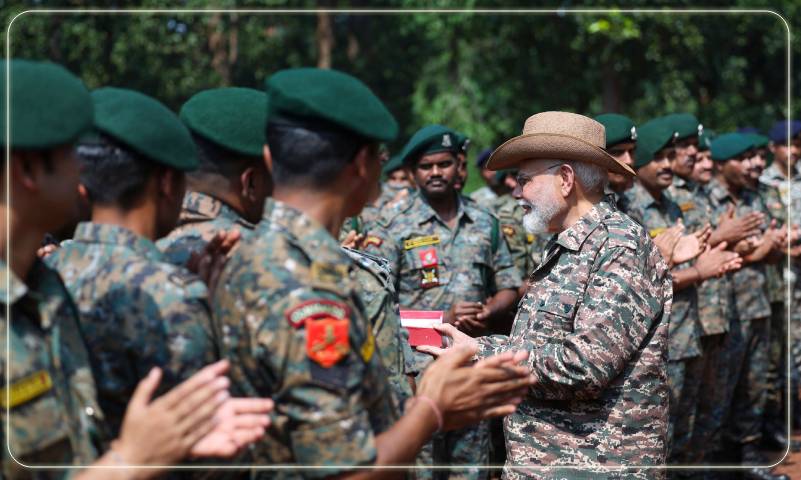
On 8 November, Prime Minister Narendra Modi celebrated Diwali with security forces at the CoBRA base in Karanpur, Bastar — calling it the first Diwali when every district is free from Naxalism, and noting no CRPF jawan had died on duty in the past year, the first such year in 47 years.
The work now shifts from security to development, the government says. Thirty-eight districts are 'Legacy and Thrust Districts' for continued support, and a third of the security camps in former Maoist areas are becoming Seva Dera Kendras, integrated development centres. Roads and mobile connectivity are reaching cut-off areas: 15,189 km of roads, 9,561 mobile towers, and 96 per cent of villages in the worst-affected areas now connected.
Officials caution against complacency: the test is whether the peace holds as forces thin out. But by the government's own measure, a conflict that shaped India's internal security debate for nearly sixty years is over.

Comments (0)
No comments yet — be the first to share your view.