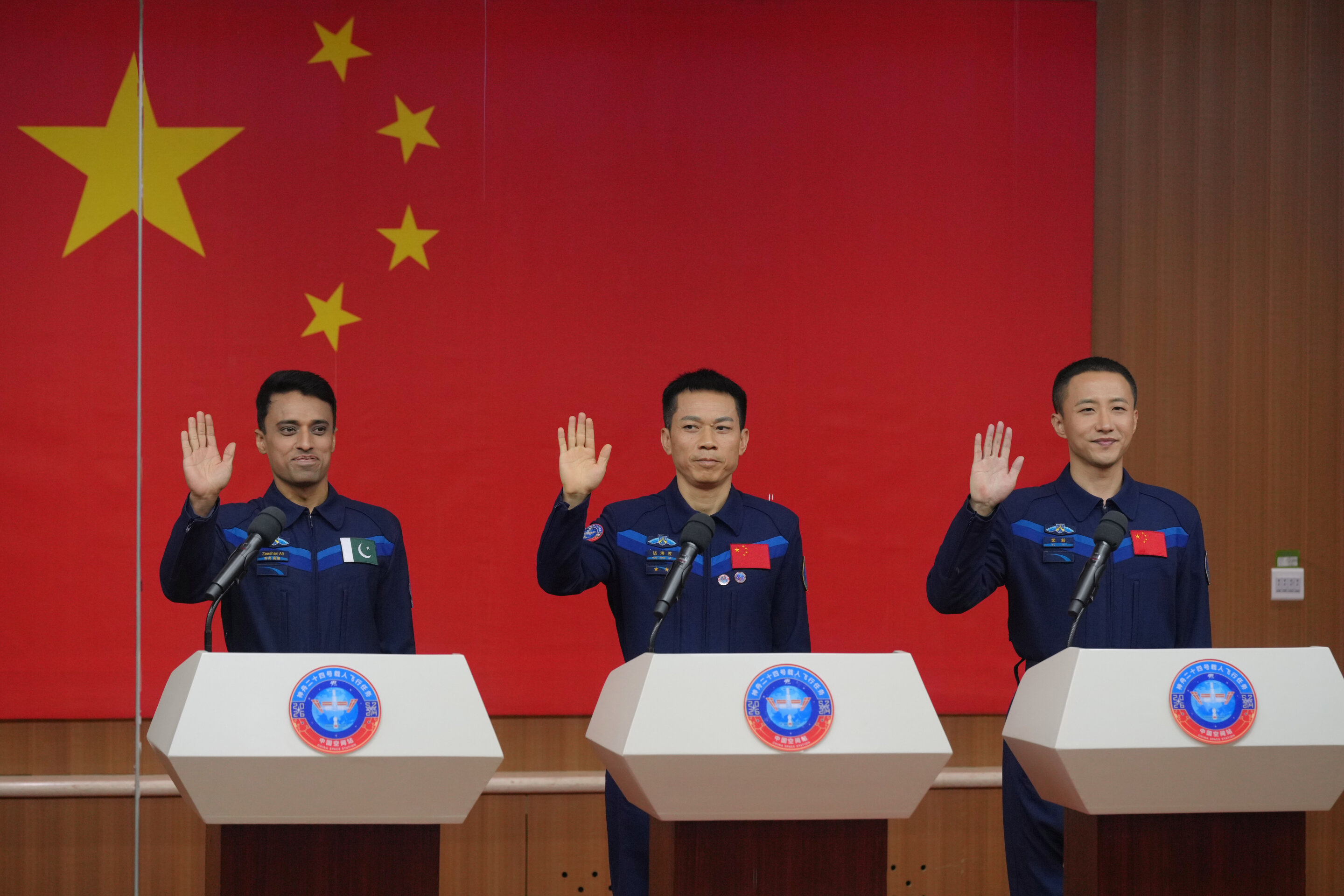
China launched the Shenzhou-24 spacecraft on Wednesday, carrying the first Pakistani into orbit and the first foreign astronaut ever to visit China's Tiangong space station.
The Long March-2F rocket lifted off from the Jiuquan Satellite Launch Centre in north-west China at 8:18 a.m. local time (0018 GMT), carrying mission commander Tang Hongbo, flight engineer Wu Yi and Pakistani payload specialist Muhammad Zeeshan Ali. The spacecraft was due to dock with Tiangong's Tianhe core module about three and a half hours after reaching orbit.
Mr. Ali, a 40-year-old Pakistan Air Force pilot, will spend about a week aboard the station before returning to Earth aboard the Shenzhou-23 spacecraft. He will conduct four biotechnology experiments developed by Pakistani universities, including an in-orbit experiment on photosynthetic cyanobacteria, and work in materials science.
A first for Pakistan — and for China
The flight is the first joint mission involving Chinese and foreign astronauts in the history of China's manned space programme. It follows an agreement signed in February 2025 between the China Manned Space Agency and Pakistan's space agency, SUPARCO, under which two Pakistan Air Force pilots — Mr. Ali and Khurram Daud — were selected after screening in China. Mr. Ali then trained for seven months in Beijing, including intensive Chinese-language classes, Chinese songs and poetry, calligraphy and table tennis.
"I'm not flying for myself. I carry the name of Pakistan on my shoulder," Mr. Ali told reporters on Tuesday, speaking at the pre-launch press conference at Jiuquan. At the same briefing he said, in Mandarin, that his flight "not only represents myself, but also my country."
For China, the mission underlines the ambition to present Tiangong — 'heavenly palace' — as a hub for international cooperation, at a time when the NASA-led International Space Station faces possible retirement by 2030. Commander Tang Hongbo, 51, is making his third visit to Tiangong, having flown on Shenzhou-12 and Shenzhou-17; Wu Yi, 39, is on his first flight.
What it means for Pakistan
Pakistan has had a space programme since the 1960s but has never before sent one of its own citizens into orbit. The federal government has proposed Rs1.29 billion for the Pakistan Manned Space Mission in its 2026-27 development programme, and officials say the Shenzhou-24 flight is the first step of a longer human spaceflight effort. Asked whether Pakistan could one day send astronauts independently, Mr. Ali replied: "Certainly that day will come."
For Beijing, the flight also carries diplomatic weight: it deepens a partnership with Islamabad that already spans infrastructure, defence and now human spaceflight, and demonstrates that Tiangong can host astronauts from other countries. More foreign visitors are expected to follow as China opens the station to partner nations.
The crew's return is scheduled in about a week, when Mr. Ali will fly home aboard Shenzhou-23 with two of the three taikonauts currently on the station.
Comments (0)
No comments yet — be the first to share your view.