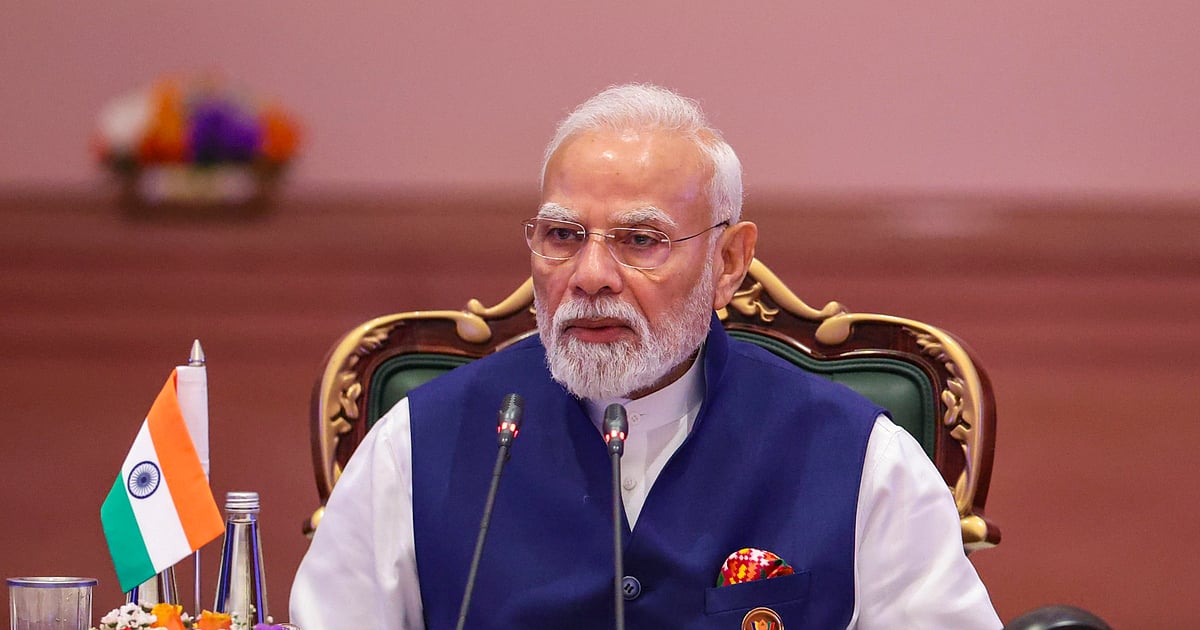
Prime Minister Narendra Modi travels to Manila on Monday for a three-day visit to the Philippines, where he will attend the 23rd ASEAN-India Summit and the 21st East Asia Summit, with maritime security, regional stability and expanding trade ties at the top of the agenda.
The visit, which runs from November 16 to 18, comes at the invitation of Philippine President Ferdinand R. Marcos Jr., whose country holds the chairmanship of the 11-member Association of Southeast Asian Nations this year. According to the Ministry of External Affairs, Mr. Modi will attend a dinner hosted by Mr. Marcos for visiting leaders on Monday evening, before taking part in the ASEAN-India Summit and the East Asia Summit process on Tuesday, with bilateral meetings with other leaders on the sidelines.
Maritime cooperation in focus
India and ASEAN have designated 2026 as the ASEAN-India Year of Maritime Cooperation, and the meetings are expected to focus on strengthening maritime security and safety, connectivity and the blue economy. The ASEAN-India Summit will also review progress on the ASEAN-India Plan of Action for 2026-2030 and chart the future direction of the Comprehensive Strategic Partnership.
The Ministry of External Affairs said India-ASEAN relations are a central pillar of India's Act East Policy and its vision for the Indo-Pacific. The partnership is marking 35 years of dialogue relations, with five years of the Comprehensive Strategic Partnership to be commemorated in 2027. This will be Mr. Modi's 13th ASEAN-India Summit since 2014.
A crowded diplomatic stage
Manila has become the centre of regional diplomacy this week, with the 49th ASEAN Summit bringing together leaders from across Southeast Asia and beyond. US President Donald Trump, Brazilian President Luiz Inacio Lula da Silva and Canadian Prime Minister Mark Carney are also expected to attend, alongside leaders including South Korean President Lee Jae Myung, New Zealand Prime Minister Christopher Luxon and Japanese Prime Minister Sanae Takaichi.
The summit's theme this year is "Navigating the Future", reflecting the region's effort to steer through trade tensions, security rivalries and the shifting balance of power in the Indo-Pacific. For India, the visit is an opportunity to deepen ties with a region that is both a major trading partner and a central arena for its strategic outreach — and to press its case for a free, open and rules-based Indo-Pacific in a room full of the world's most consequential leaders.
Comments (0)
No comments yet — be the first to share your view.