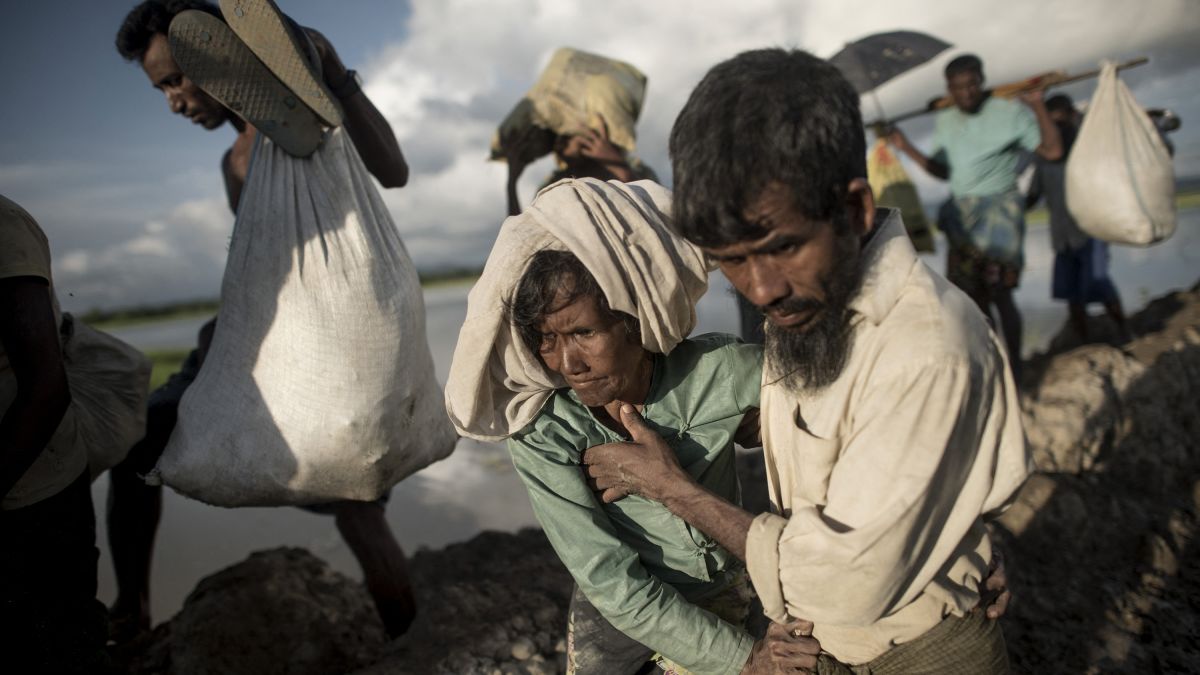
The International Court of Justice ruled on Thursday that Myanmar committed genocide against its Rohingya minority, the first time in the court's 80-year history that it has held a state responsible for the crime.
Delivering the judgment at the Peace Palace in The Hague, the court's president, Judge Iwasawa Yuji, said it was "fully convinced" that Myanmar acted "with an intent to destroy a substantial part of the Rohingya population" in northern Rakhine State during the military's 2017 "clearance operations". The decision was taken by nine votes to six.
"The only reasonable inference that can explain Myanmar's actions is an intention to destroy" the Rohingya population in northern Rakhine State, Judge Iwasawa said during a reading that lasted nearly three hours.
What the court found
The court found that Myanmar's security forces engaged in indiscriminate killings — about 10,000 Rohingya died violently during the operations — and gave particular weight to "widespread acts of sexual violence, and extreme acts of violence against children", and to attacks on Rohingya as they fled in large numbers to Bangladesh.
The court found the scale and nature of the atrocities "went well beyond what would be required to punish the population and are instead characteristic of an intent to destroy a substantial part of the group". More than 700,000 Rohingya fled into Bangladesh in 2017, creating one of the world's largest refugee crises; most remain in camps in Cox's Bazar.
The court ordered Myanmar to make reparations, including facilitating the safe, voluntary and dignified return of the Rohingya and family reunification, and the return of property lost or damaged. It also ordered guarantees of non-repetition, and said Myanmar must investigate and punish genocide suspects, with compensation to be determined later.
A seven-year case
The case was brought in November 2019 by The Gambia, a small West African nation acting with the backing of the Organisation of Islamic Cooperation, under the 1948 Genocide Convention, which lets any state party sue another it believes has breached the treaty. Seven years of evidence and testimony followed before the final judgment.
Myanmar denied genocide throughout, arguing that its forces were responding to attacks by the Arakan Rohingya Salvation Army. The United States and Canada had previously declared the atrocities a genocide. Myanmar's rulers reject the finding.
Binding, but no enforcement arm
ICJ rulings are final and binding and cannot be appealed, but the court — which settles disputes between states — has no power to enforce its decisions. Its orders go to the UN Security Council, which could act on them through a resolution.
For survivors, the judgment's significance is hard to overstate. "Today the world's highest court has looked at what was done to the Rohingya and named it for what it was. Genocide," said Yasmin Ullah, a Rohingya activist in The Gambia's delegation. UN human rights chief Volker Türk and Amnesty International welcomed the ruling, while cautioning that accountability will depend on what follows — above all, whether the Rohingya ever go home.


Comments (0)
No comments yet — be the first to share your view.